
You Cannot Surrender a Self You Never Developed
The Hidden Problem with Ego Death and the Path to a Healthier Spirituality


If my work brings insight, encouragement, or challenge to your spiritual journey, please consider becoming a paid subscriber. You’ll get full access to all articles, events, and our progressive Christian community—and you’ll help keep this work sustainable.
If cost is a barrier, just reply to this email. I’ll gift you a 3-month paid subscription, no questions asked.
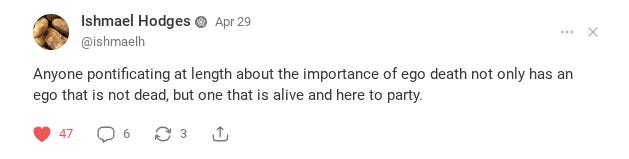
That caught my eye on Substack Notes.
I chuckled.
It’s probably spot on.
(Btw, if you are not following or subscribed to Ishmael Hodges yet, you probably want to consider it. Also, he’s trying to save his beloved cat who needs medical care. So if you have any change to spare, please consider supporting them through his GoFundMe. They are getting pretty close to their goal. Please help them cross the finish line.)

Surprisingly, that Note affected me a bit more than expected. It made me think more fully about the problems of ego death as a concept and how it is used.
If you’ve spent any amount of time in mystical circles, you’ve almost certainly encountered the idea. Whether we’re talking about Christian mysticism, Buddhism, non-dual spirituality, or any contemplative practice in general, the concept appears again and again. The language varies, but the basic idea remains largely the same.
The ego is understood as the thing that separates us from Ultimate Reality. It is the thing that creates division, suffering, conflict, and alienation. Therefore, spiritual growth becomes a process of transcending the ego, dissolving the ego, or even killing the ego altogether.
For many people, that is the mystical quest itself.
The goal is to let go of the “small self” so that one can awaken to a larger reality. Sometimes that reality is described as union with God. Sometimes it is described as enlightenment. Sometimes as oneness with the universe.
Whatever language is used, the underlying movement is similar. The boundaries that separate self from others begin to dissolve, and the individual discovers a deeper level of connection with everything around them.
I dig this. I would argue that there is something profoundly important happening within the concept of ego death.
But I still have a problem with it. My problem is not that the concept points us in the wrong direction. The problem is that it is often oversimplified.
Like many spiritual ideas, it can become detached from the wider framework that gives it deeper meaning. Once that happens, something that was intended to promote life can produce unintended, harmful consequences.
Before we can talk about the problems, however, we need to understand what the ego is and why so many spiritual traditions are concerned with it in the first place.
What’s the Problem with the Ego?
When people hear the word ego, they often think of arrogance. Someone with a big ego is prideful, self-important, and constantly seeking attention. While that is one way the word gets used, it is not what I mean here.
When I talk about the ego, I am referring to our conscious sense of self. The ego is our experience of being “me.” It is the collection of memories, beliefs, values, relationships, and experiences that together create our sense of identity. It is the story we tell ourselves about who we are.
And contrary to some popular ego-death spirituality, there is nothing inherently wrong with that.
In fact, the ego serves an important purpose. Human beings are social creatures. We evolved in communities where belonging was tied directly to survival. As a result, we developed sophisticated ways of understanding ourselves and our relationship to others.
The ego emerges as part of that process. It helps us navigate social life. It helps us understand where we belong. It helps us make decisions, establish relationships, and move through the world as distinct individuals.
The challenge is that the ego establishes identity through difference. We know who we are partly because we know who we are not. Difference helps create meaning. Without distinctions, identity itself becomes difficult to imagine.
The problem arises when difference becomes opposition.
We naturally identify with people who feel familiar. We tend to connect more easily with those who share our values, experiences, beliefs, or social groups. The more we identify with someone, the easier it becomes to care about them. The less we identify with them, the harder it can be to understand them. And when understanding breaks down, fear often takes its place.
This is where the ego can become destructive.
The same mechanism that allows us to develop a healthy sense of self can also create walls between ourselves and others. It can lead us to divide the world into insiders and outsiders, friends and foes, people who matter and people who don’t. We see this dynamic everywhere—in politics, religion, nationalism, racism, and countless forms of tribalism.
The problem, then, is not that the ego exists.
The problem is that it often becomes trapped within a narrow understanding of who belongs within its circle of concern.
What Is Ego Death?
Once we understand the problem, it becomes easier to understand what spiritual traditions are trying to accomplish through ego death.
At its heart, ego death is not really about destroying the self. It is about loosening the rigid boundaries around the self. It is about expanding our capacity for identification with otherness.
Compassion flows from identification.
When someone we love suffers, we suffer with them. When someone we care about experiences joy, we often share in that joy. Their well-being matters to us because, in some sense, we experience them as extensions of ourselves.
However, our identification is usually selective. We identify easily with family, friends—people who belong to our tribe. Beyond those boundaries, identification becomes more difficult.
Spiritual traditions have long sought ways to expand the circle.
The mystical path, in particular, is often an attempt to help people move beyond a narrow sense of self and toward a deeper awareness of their connection with others. Different traditions use different language for this process. Some speak of union with God. Others speak of the Ground of Being, Buddha Nature, or universal consciousness. Whatever terminology is used, the movement is remarkably similar. The individual begins to experience themselves as participating in something larger than their ordinary identity.
When this happens, the experience of otherness begins to soften.
If all people are children of God, then they belong to the same family. If all people emerge from the same Ground of Being, then they share a common source. If all people participate in the same sacred Reality, then the distinctions that once seemed absolute begin to appear less ultimate.
Notice what is happening here.
Otherness is not being overcome through force.
It is being overcome through identification.
The mystic discovers a deeper level of sameness beneath the differences.
Mystical Experience
This is why mystical experiences can be so powerful. Their significance is not merely that they feel extraordinary. Their significance is that they reorient our perspective. They allow us to glimpse a reality in which the divisions that normally dominate our thinking seem less important than we once believed.
The stranger becomes less strange.
The outsider becomes less outside.
The enemy becomes more human.
The boundaries do not disappear entirely, but they become more permeable.
This, I think, is the deepest insight hidden within the language of ego death. At its best, ego death is not a journey toward self-destruction. It is the gradual death of a narrow and parochial sense of self so that a wider and more universal sense of self can emerge.
And that is why the concept has remained so compelling throughout the history of mysticism.
Eclectic Mass is Live!
Eclectic Mass is a spiritual formation community for people who still want depth, practice, and connection—even if traditional church no longer fits.
Paid subscriptions are 1/2 off (only $2.50) for the first 3 months.
The Spiritual Binary
One of the primary ways human beings make sense of reality is through contrast. We understand what something is by understanding what it is not. This tendency helps us learn, categorize, and navigate the world. It is one of the strengths of human cognition.
The problem is that the same habit can sometimes limit our understanding.
When we encounter a new idea, we often begin by thinking about it in binary terms. We understand the new thing by contrasting it with the old thing. This can be useful at first, but if we never move beyond that initial contrast, the binary itself can become a trap.
(Non)Dualism
I often think about this when people talk about non-dualism.
Several years ago, I came across a social media post where someone basically said, “I’m no longer a dualist. I’m now a non-dualist.”
At first glance, that seems like a perfectly reasonable statement. But the more I thought about it, the more interesting it became.
A dualistic mindset tends to divide reality into opposing categories. This versus that. Us versus them. Right versus wrong. A non-dual perspective seeks to move beyond those rigid divisions toward a deeper recognition of interconnectedness.
And yet the person’s description of themselves was...
I am not this.
I am that.
Dualism is over there. Non-dualism is over here.
One is rejected and the other embraced.
It was a dualistic understanding of non-dualism.
I do not point this out as a criticism. In fact, I think it is a normal part of learning something new. Whenever we encounter a transformative idea, we initially understand it through the categories we already possess. We bring our old habits of thinking into the new worldview.
Over time, however, something deeper can emerge.
A mature understanding of non-dualism does not reject dualism. It transcends and includes it. We continue to recognize differences, distinctions, and individuality, but we no longer treat those differences as absolute separations. Unity and diversity are held together.
Okay, Back to Ego Death
I think something similar happens with ego death.
When people first encounter the concept, it is easy to create a binary.
Ego is bad.
Ego death is good.
The ego becomes the enemy.
Its absence becomes the goal.
At first, that binary may even be helpful. It challenges a narrow, self-centered way of existing in the world and points toward a larger vision of reality.
The problem arises when the binary becomes permanent.
If ego is always the enemy, then developing a healthy sense of self can begin to look spiritually suspect. Boundaries can begin to look selfish. Individuality can begin to look like a problem. The work of becoming a mature human being can begin to seem less important than the work of transcending humanity altogether.
This is where I think the language of ego death can become misleading.
Just as non-dualism ultimately transcends and includes dualism, healthy spirituality must transcend and include the ego. The goal is not to eliminate the self. The goal is to place the self in proper relationship with otherness.
We become more fully ourselves, and more deeply connected to others.
We develop a stronger sense of identity, and a greater capacity for identification.
The question, then, is not whether ego death contains wisdom. I believe it does. The question is whether the language itself adequately captures the complexity of what is actually happening.
Want to Find Out More About My Personal Mystical Path?

My Criteria for Evaluation
Whenever I enter into a process of spiritual discernment, I try to keep one question in front of me:
To what extent is this life-enriching?
That question has become increasingly important to me because I have encountered countless spiritual ideas that contain genuine wisdom while sometimes producing harmful outcomes. The fact that something contains truth does not automatically mean it will be helpful in every situation. Nor does it mean it is being communicated wisely.
Consider forgiveness. Forgiveness can be deeply healing. It can free people from bitterness and resentment. It can restore damaged relationships and open the possibility of reconciliation. Yet forgiveness can also be weaponized. It can be used to pressure people into remaining in abusive situations or to silence legitimate anger. The problem is not forgiveness itself. The problem is how it is understood and applied.
The same could be said about surrender, humility, obedience, sacrifice, and countless other spiritual concepts.
This is one reason I have become increasingly attentive to language. Spiritual leaders are not only responsible for the ideas they intend to communicate. They are also responsible for considering how those ideas are likely to be heard.
Words matter because people build lives around them.
If someone hears that spiritual maturity requires dying to themselves, they may begin evaluating every desire, boundary, and act of self-care through that lens. The question is not merely whether a concept is true. The question is what kinds of lives it tends to create.
Does it promote greater compassion?
Does it encourage freedom and flourishing?
Does it help people become more fully human?
Those are the questions I bring to the language of ego death. My concern is not whether the concept contains wisdom. I believe it does.
My concern is whether the way it is often presented serves the larger goal of life-enriching spirituality.
Because once we move beyond theory and into lived experience, some difficult questions begin to emerge.
Questions about abuse.
Questions about emotional maturity.
Questions about human development.
And it is there, I think, that the limitations of the concept become most visible.
